



Footnotes
The evidence that shapes our opinions
October “Jude is not a politician” Mailer

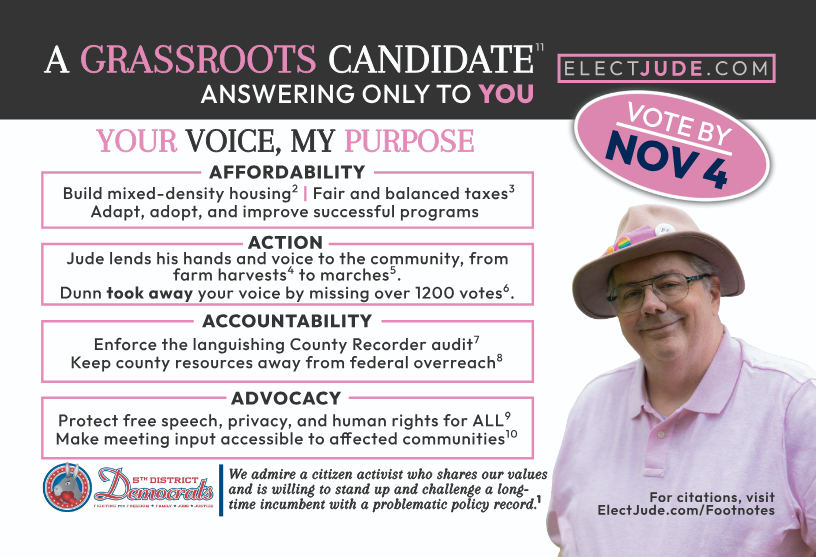
-
Along with the 4 endorsements listed on the mailer, Jude is endorsed by The Stranger, the Democratic Party in 4 LDs, and several other non-political-party groups and individuals that you can find on the Endorsements page.
Beyond endorsements, Jude also received the 2025 Moms Demand Action Gun Sense Candidate Distinction, and is recommended for this position in the Progressive Voter’s Guide -
For young people like my daughters, a "starter home" is out of reach even with a tech career. Seniors can't find modest accessible homes to downsize into. Families have to live far from where they work, creating traffic and pollution problems.
It wasn't always like this. Historical cities have a variety of home types with businesses in walking distance. We now know that single-detached zoning makes housing more expensive and communities less prosperous.We should re-legalize communities with homes of all shapes and sizes, for all types of families.
-
Thanks to our new capital gains tax, Washington's tax system is no longer the most regressive in the nation; now it's second most regressive. But our state constitution prohibits anything other than proportional taxes.
Since high-income earners have more money to save and invest, they do not spend a similar proportion of their income as low-income families, and bear less of the sales tax burden. In fact, the lowest-income 20% of families pay 13 times as much, proportionally, than the top 1% .
Jude proposes replacing those effectively disproportional sales taxes with a combined county-wide simple income tax and offsetting Universal Basic Income tax credit. This plan would provide more credit than tax for families of 4 making less than $150K in income, rebalancing the tax burden to those who are most able to bear it. -
Jude has gleaned from Ayeko Farm and harvested at Elk Run Farm, cleaned trash from the Cedar River , and farmed in Sustainable Renton's community garden.
He included charity food drives into his campaigning and canvassing, collecting donations in his own neighborhood, Ten Trails, and Newcastle. -
Jude attends events with Maple Valley Indivisible, WAISN, and other organizations. He marched with the postal service in August, and commits to joining unions on the picket line.
-
Using publicly available data from the King County Clerk of the Council website, we found that Dunn was recorded as “Excused” for 1207 of the recorded votes.
Of particular concern, we also found that he made Facebook posts while he was supposed to be paying attention to reports or voting. We haven’t investigated in depth, so here are a couple we found by coincidence:
July 17, 1:01pm - 3:01pm Board of Health Meeting. 2:16pm Facebook post
July 22, 9:34am - 11:50am Committee of the Whole. At 10:23 AM (during a briefing about Harborview Medical Center, per the meeting recording. Dunn made a Facebook post about touring a new skate park.
Our methodology is outline in citation 19 from the “When We Vote We Win” mailer.
If there are any particular categories of votes you are interested in, please contact us, and we will do our best to get you our aggregated data about Dunn’s voting and attendance record on that subject.
-
Last year, the auditor found that the King County Recorder had misallocated and overcharged $8M. The auditor made 17 recommendations, and in the past year 0 of them have been acted upon. Other audits have made progress much more quickly (pcards, vanpool).
We should expect the highest standards and integrity from all county offices, including the one that records taxes and other documents.
-
King County Council passed a law in 2009 to ensure immigrant residents had access to public health facilities and resources, and that, functionally, federal agents could not profile immigrants or arrest them without probable cause.
In 2016, the council strengthened those protections, limiting how county employees could collect data about immigration status, banning county employees from detaining individuals on behalf of federal law enforcement, and, importantly, banning employees from expending county resources on facilitating federal immigration enforcement, except where required by law. (Note that ICE Administrative Warrants are not legal documents and do not compel anyone other than ICE agents.)
Ordinance 18665 Section 2I prohibits King County employees from spending any county time, money, or resources assisting in immigration activity unless a judicial warrant compels them. If ICE wants to get information about King County residents from King County records, they must go through a judge to do it.
In 2025, the council expanded the protections further to require that contractors providing services to King County be held to the same standards as employees, so that ICE could not use the contractors to get around the law.
This law helps to prevent our residents from being abducted without warning, and helps to ensure that every resident gets due process.
Reagan Dunn voted no on all three ordinances.
Jude proposes expanding the ordinance to include organizations that work with ICE. -
As described above, Jude is committed to enforcing and strengthening King County ordinances preventing federal organizations from using county resources.
He also supports legislation keeping outside organizations from accessing private data without a legal mandate, including tax records, benefit filings, and other personally identifiable data.
Where Reagan Dunn was the sole no vote on a (non-binding) resolution affirming Roe v Wade, and even joined “Don’t Say Gay” governor Ron DeSantis’s presidential campaign (yes, the one who signed a 6-week abortion ban), Jude has been consistently supportive of human rights and bodily autonomy, including the rights of abortion, gender affirming care, and general medical care access.
-
King County Council meetings are not accessible to most people: they're held during work hours on weekdays, in a city without public transit access to most of our district, and limited driveability and parking.
Jude plans to bring the meetings to the residents of King County, in places they already meet, at times they can attend. If elected, Jude plans to retrofit a cargo van to provide internet access, livestreaming hardware, video and audio recording capabilities, and an interview booth. Jude will bring this van to communities affected by King County Council's upcoming votes to proactively get residents' input. Jude wants to give them the chance to share their concerns and stories, as well as to provide recorded, written, or live remote testimony to the Council as a whole.
Jude wants to hold these events at both existing community centers and events, where residents already gather, as well as in more remote areas that may otherwise be overlooked. -
The Public Disclosure Commission records all the reported donors for political candidates in Washington. Jude’s reports show small donations from individuals, self-funding, and access to canvassing tools. He is not obligated to any party, corporation, or individual.
Reagan Dunn’s reports show donations from MAGA-supporting multi-millionairesBryan and Rochelle Heywood (the same Bryan Heywood who abuses our citizen initiative process), Trump Victory Fund mega-donor Kemper Freeman Jr (through Kemper Holdings LLC), and Amazon and Microsoft (both companies that provide computer services for the war in Gaza).
October “When we vote we win” Mailer
-
King County’s official results show on page 3 that the Metropolitan King County Council District No. 9 race had 38.25% turnout, with 61,000 ballots counted.
Reagan Dunn won the election with 36,169 votes against Kim-Khanh Van’s 21,895.
-
In 2024, District 9 cast 136,831 votes in the presidential election.
Notes on data collection:
This is normally a difficult number to find. It's trivial to find voting data for counties and congressional districts as a whole, and the Washington Secretary of State website provides a downloadable precinct-level breakdown of votes cast during each election. But election data isn't usually collected at the level of County Council districts.
However, King County provides a list of precincts and their associated districts in a downloadable format, and it's possible to correlate these with the precinct codes in the Secretary of State's data. This means it was possible to get King County Council District 9 voting results aggregate the precinct-level data for the precincts that make up our district. -
In 2024, District 9 cast 78984 votes for Harris, 52571 votes for Trump, and 5276 votes for all other candidates combined.
Those nearly 79k votes cast for Harris account for 60% of the 136.8k votes cast in District 9, and Trump's votes accounted for 39.9%.
Our data collection method is the same as from Footnote 2, aggregating Washington Secretary of State precinct-level data. -
You can see all of Reagan Dunn’s reported donors for his 2025 campaign on the PDC website at https://pdc.wa.gov/political-disclosure-reporting-data/browse-search-data/candidates/567421#contributions
-
On March 20, Dunn accepted maximum-value donations from multi-millionaire couple Brian and Rochelle Heywood.
Brian Heywood has spent millions to get anti-climate and anti-trans initiatives on our ballots. Heywood has also donated significant amounts to Trump appointees Joe Kent and Robert F Kennedy Jr., and Trump’s 2016 transition team vice-chair Cathy McMorris Roberts.
-
On September 30, 2025, Reagan Dunn accepted a maximum-value donation from Freema Holdings LLC, a family-owned real estate company also known as Kemper Development, run by Kemper Freeman Jr.
As of 2016, Freeman and his daughters held the majority stake in his family’s estimated 2 billion dollars of holdings.
Though Freeman served in the Washington State House of Representatives as a Democrat in the 70s, he also donated $100,000 to the Trump Victory Fund, and has been consistently donating to Republicans and Republican Parties across the country in the past several years, including local MAGA candidates.
-
On May 16, Reagan Dunn received the maximum allowable contribution from Amazon.
Amazon has several instances of war profiteering: In Israel, “It provides cloud services to all branches of the Israeli government, including the military…weapons manufacturers…and government agencies related to Israel's illegal settlement enterprise in the occupied West Bank.”
Amazon also owns almost a 20% stake in the airline that provides deportation flights for ICE, and hosts a variety of systems related to immigration surveillance, case management, and processing, as well as systems specifically used for targeting citizens for citizenship revocation, and attempted to expand into facial recognition for ICE use.
-
King County Council passed a law in 2009 to ensure immigrant residents had access to public health facilities and resources, and that, functionally, federal agents could not profile immigrants or arrest them without probable cause.
In 2016, the council strengthened those protections by:Limiting how county employees could collect data about immigration status
Banning county employees from detaining individuals on behalf of federal law enforcement
Banning employees from expending county resources on facilitating federal immigration enforcement, except where required by law.
That last point is important; ICE regularly uses what they call Administrative Warrants to perform extrajudicial arrests and raids. But administrative "warrants" are not the same thing as a Judicial Warrant.
Administrative "warrants" are forms signed by ICE employees, saying what they want to do. They do not give ICE agents the legal right to enter private areas or access private data.
Only a Judicial Warrant signed by a judge can provide that access. Without a Judicial Warrant, any forced, compelled, or even consenting access is extrajudicial and warrantless - regardless of what ICE wants to call their form.
Ordinance 18665 Section 2I from 2018 means that without a Judicial Warrant, King County employees may not spend any county time, money, or resources assisting in immigration activity. If ICE wants to get information about King County residents from King County records, they must go through a judge to do it.
In 2025, the Council expanded the protections further to require that contractors providing services to King County be held to the same standards as employees, so that ICE could not get around the law by having our contractors spend our resources helping them.
This law helps to prevent our residents from being abducted without warning, and helps to ensure that every resident gets due process.
Reagan Dunn voted no on all three ordinances.Jude would have voted yes, and supports expanding the ordinance to include organizations that work with ICE.
-
On November 12, 2024, King County Council passed Motion 2024-0279, to develop a regional workforce housing initiative implementation program. The vote passed 8-1, with Reagan Dunn opposing.
The text of the motion is available as Motion 16690, and the meeting minutes are available on the King County Legislation website.
This bond will be leveraged to increase housing availability for low-income households, combat the homelessness crisis, and stabilize the housing market in King County. The King County Executive proposed his plan for the bond in June 2025.
-
Jude wants to leverage King County’s construction bond to fund conditional second mortgages for owner-built accessory dwelling units (ADUs).
Accessory Dwelling Units are secondary structures on a property, designed for independent living. You may have heard of them as “mother-in-law suites” or “granny flats”. They can be as small as a tiny home in your back yard, or a full second house on multiple acres of land - as long as they meet local code requirements.
Because the land is already owned, ADUs can be built far cheaper than most single family homes. And since ADUs are lower in cost to build, and smaller than single-family homes, they are often rented at below market value, according to the 2023 WA State legislature.
This makes ADUs ideal candidates for low-income housing.
King County can encourage this sort of building by offering conditional second mortgages to homeowners building ADUs - with lower interest rates or partial deferrals as long as they participate in the Housing Choice Vouchers program or other low-income rental programs.
Jude’s plan for conditional second mortgages to fund these ADUs will stretch the construction bond further.
The prototypical example of conditional second mortgages is Habitat for Humanity. To allow low-income households to afford their homes, Habitat provides these second mortgages at very low interest rates, with ample opportunities for deferment and forgiveness. The terms of the mortgage result in near-guaranteed income going back to Habitat for Humanity, which they can use to build homes in the future.
Using the bond for these conditional second mortgages would stretch the bond money further in a few ways:
ADUs are cheaper than single family homes, meaning more ADUs can be funded with the same amount of money
The second mortgages will be for a portion of the construction cost, rather than the full construction cost, again funding more units.
Mortgages are near-guaranteed return income, especially given that the mortgages are being used to build rental units
Building in existing neighborhoods decreases infrastructure costs compared to new construction,
Additionally, this will benefit all parties involved in several ways:
For homeowners: Building the ADU provides consistent rental income, made even more consistent by participation in the HCV program. The lowered cost from the second mortgage makes this available to more people.
For the county: Collaborating with homeowners will increase buy-in for new construction in and around local neighborhoods. It will also expand availability of HCV housing, which has not opened its waitlist since 2020, according to its website.
For the renters: Living in an established neighborhood means that the communities already have all the necessary facilities available. The renters will have immediate access to well-funded resources shopping centers, schools, and medical facilities.
-
On 10/29/2024, the Budget and Fiscal Management Committee advanced 2024-0279, the $1B bond discussed in footnote (8) to build affordable housing. In OVER AN HOUR of discussion, Dunn spoke only to vote NO (Meeting recording, at 1:19:28).
At the general meeting on 11/12/2024, Dunn again opposed the bill without discussion. -
Ordinance 2021-0131 required landlords to provide just cause to evict tenants. Given the impact of the pandemic, it was sorely needed.
At the 6/29/2021 vote, Dunn voted no.
If Dunn got his way, landlords would have been allowed to evict even tenants who were paying on-time and consistently, who kept their units clean and well-maintained, and who had never caused a noise complaint or HOA violation.
Dunn has also voted against other tenant protections, such as a recent ordinance prohibiting algorithmic rent fixing (2025-0267). -
At the 10/13/2020 meeting, Dunn voted against 2020-0337, an ordinance for building shelter for the homeless.
This ordinance specifically indicated a need for funding 6500 units of supportive housing for individuals experiencing chronic homelessness, including those who need substance use disorder treatment.
-
Reagan Dunn was the sole no vote on Motion 2022-0190, which affirmed Roe v. Wade preparation for the Supreme Court’s anticipated repeal of federal abortion protections in Dobbs v. Jackson.
His prepared statement in response to news organizations did not clarify - and in fact his claim of “support [for] a woman’s right to make her own decision” and that legality “should be left to the states to decide” is exactly contradictory to his vote.
If this motion were raised with Jude in office, it would have passed unanimously. Jude has been consistent supportive of human rights and bodily autonomy, including the rights of abortion, gender affirming care, and general medical care access.
-
In October 2023, Reagan Dunn joined Ron DeSantis’s presidential campaign, and called him the “future of the Republican Party”.
This was after Ron DeSantis had, as Governor of Florida, signed a 15-week abortion ban law in April of 2022, then fought in court to uphold it, then advocated for and ultimately signed into law a 6-week abortion ban in April of 2023.
These abortion bans, and DeSantis’s “Don’t Say Gay” bill are his most famous policies. Dunn himself said of DeSantis “I’ve seen what he’s done in Florida, and now I’m ready to see what he can do for the country as president”
-
In May 2025, Governor Ferguson signed HB 2015, a $100 million funding bill for criminal justice purposes.
Jude wants to use some of this funding to guarantee quick, appropriate emergency responses, by hiring additional officers and support and responding staff, including social workers and behavioral health professionals.
HB 2015 allows funding to be used for a wide variety of criminal-justice-related programs and systems, meaning that we have an opportunity to expand successful emergency response programs that involve non-police interventions.
Jude wants to expand programs like:
Bellevue’s Community Crisis Assistance Team, which was tested in a 4-month pilot program that had fantastic results diverting individuals in crisis from arrest by connecting them with mental health professionals.
Olympia’s Crisis Response Unit, in which behavioral health staff responds to 911 calls and potential crisis situations independently of police. CRU averages 500-600 contacts per quarter, with 0 injuries caused by clients in 3,108 total calls taken, and about 80% of calls not involving police presence at all
The FD Cares team in Kent, which has numerous successes such as with a chronic 9-1-1 caller, and who responded to over 1000 calls in 8 months, getting care for both their direct patients, and the people around them. FD Cares is such a success that it saved $600k/year for the fire department and $1 million for the health for the fire department and $1 million/year on health care.
-
Though Reagan Dunn purports to prioritize criminal justice and public safety, he voted against 2025-0169, a one-tenth of one percent sales tax to fund staffing, domestic violence programs, and other criminal justice and public safety programs.
-
Reagan Dunn missed the committee vote for Ordinance 2018-0373, then voted no on the final vote.
This ordinance was for requiring secure storage of firearms in a gun safe or similar - a common-sense measure that any responsible gun owner should already be practicing.
Jude is a strong proponent of gun safety - he has even been awarded the 2025 Moms Demand Action Gun Sense Candidate Distinction. Jude would have voted to pass this ordinance
-
This statistic was calculated by a member of Jude’s campaign, using publicly available data from the King County Clerk of the Council website.
Of the recorded votes, we found 1207 votes where Dunn was recorded as “Excused”.
Of these, 291 were officially indexed (i.e. tagged) as Appointments.
By our own subject analysis, 227 of the votes Dunn missed were “Appointment”s - a similar number, though our analysis clearly did not identify all the appointment votes he missed.We also found that 121 of the votes Dunn missed were related to “Parks”, and 129 were “Agreement”s (e.g., union contracts, purchases and sales of property, fire and police department service agreements).
If there are any particular categories of votes you are interested in, please contact us, and we will do our best to get you our aggregated data about Dunn’s voting and attendance record on that subject.
In addition to missing votes, Dunn also had some strange and concerning opposition votes. Notably, on at several occasions, Dunn has voted No on even acknowledging receipt of statutorily mandated reports brought to the Council, including an Critical Areas environmental management plan report, and three reports on budget requirements and policy recommendations for public safety programs he disagrees with (a diversion program, a restorative justice framework, and community-based alternatives to youth detention), each of which he opposed acknowledging twice.
-
July 17, 1:01pm - 3:01pm Board of Health Meeting. 2:16pm Facebook post
July 22, 9:34am - 11:50am Committee of the Whole. At 10:23 AM (during a briefing about Harborview Medical Center, per the meeting recording. Dunn made a Facebook post about touring a new skate park.
-
Voted against an Increase to Solid Waste Disposal Fee (Trash pickup) This is in strategic climate action plan and comprehensive solid waste plan.
Voted against accepting 30-year forest plan; and (per budget requirement) acknowledge receipt of an environmental monitoring plan proposal.
August Tri-Fold Brochure
-
-
https://pubmed.ncbi.nlm.nih.gov/39281422/
No paywall version of above: https://www.nber.org/system/files/working_papers/w26942/w26942.pdf
Written analyses: https://frac.org/programs/supplemental-nutrition-assistance-program-snap/positive-effect-snap-benefits-participants-communities
https://www.prb.org/articles/what-investment-offers-a-60-fold-return-food-stamps/
-
Community-led nonprofits are interconnected with the people they are helping with, and know how to help them best. They do effective work despite being chronically underfunded, and additional funding would increase the amount of people they can help, and decrease the number they have to turn away.
https://www.globalgiving.org/learn/why-community-led-nonprofits-deserve-your-investment/ -
-
King County’s Public Health Centers are medical centers that will provide care to anyone in need, and will not turn anyone away due to inability to pay. https://kingcounty.gov/en/dept/dph/health-safety/health-centers-programs-services/public-health-centers
King County has several additional programs that supplement these facilities’ programs, such as:
the Alien Emergency Medical Program, which pays for non-citizen residents who would otherwise qualify for Medicaid to have emergency medical care
the Community Health Access Program (CHAP), which helps King County residents find healthcare, health insurance, dental care, specialty children’s care, and financial assistance programs for food and energy.
Health Care for the Homeless Network and the Street Medicine Program, which focus on health care services and medical outreach for people experiencing homelessness.
-
On November 12, 2024, King County Council passed Motion 2024-0279, to develop a regional workforce housing initiative implementation program. The vote passed 8-1, with Reagan Dunn opposing.
The text of the motion is available as Motion 16690, and the meeting minutes are available on the King County Legislation website.
This bond will be leveraged to increase housing availability for low-income households, combat the homelessness crisis, and stabilize the housing market in King County. The King County Executive proposed his plan for the bond in June 2025.
-
The prototypical example of conditional second mortgages is Habitat for Humanity. To allow low-income households to afford their homes, Habitat provides these second mortgages at very low interest rates, with ample opportunities for deferment and forgiveness. The terms of the mortgage result in near-guaranteed income going back to Habitat for Humanity, which they can use to build homes in the future.
Accessory Dwelling Units are secondary structures on a property, designed for independent living. You may have heard of them as “mother-in-law suites” or “granny flats”. They can be as small as a tiny home in your back yard, or a full second house on multiple acres of land - as long as they meet local code requirements.
Because the land is already owned, ADUs can be built far cheaper than most single family homes. And since ADUs are lower in cost to build, and smaller than single-family homes, they are often rented at below market value, according to the 2023 WA State legislature.
This makes ADUs ideal candidates for low-income housing.
King County can encourage this sort of building by offering conditional second mortgages to homeowners building ADUs - with lower interest rates or partial deferrals as long as they participate in the Housing Choice Vouchers program or other low-income rental programs.
This use of the bond would stretch the bond further in a few ways:
ADUs are cheaper than single family homes, meaning more ADUs can be funded with the same amount of money
The second mortgages will be for a portion of the construction cost, rather than the full construction cost, again funding more units.
Mortgages are near-guaranteed return income, especially given that the mortgages are being used to build rental units
Building in existing neighborhoods decreases infrastructure costs compared to new construction,
Additionally, this will benefit all parties involved in several ways:
For homeowners: Building the ADU provides consistent rental income, made even more consistent by participation in the HCV program. The lowered cost from the second mortgage makes this available to more people.
For the county: Collaborating with homeowners will increase buy-in for new construction in and around local neighborhoods. It will also expand availability of HCV housing, which has not opened its waitlist since 2020, according to its website.
For the renters: Living in an established neighborhood means that the communities already have all the necessary facilities available. The renters will have immediate access to well-funded resources shopping centers, schools, and medical facilities.
-
Bellevue’s 4-month pilot program of a Community Crisis Assistance Team made 1785 contacts with or on behalf of 239 clients - that’s on average 7.5 interactions that each client had with trained mental health professionals instead of with armed police officers.
This short pilot resulted in a 24% reduction in use of force by police officers, 80% fewer arrests, and 45% of clients being referred to the Bellevue Fire Department CARES team for ongoing case management.
-
Olympia has a Crisis Response Unit, in which behavioral health staff responds to 911 calls and potential crisis situations independently of police.
In April through June of 2020, the CRU responded to 511 incidents, 425 of them entirely without police presence.
CRU averages 500-600 contacts per quarter with only 4 crisis response specialists and 2 crisis response lead workers. Out of 3,108 total calls taken, 0 injuries have been caused by clients.
-
In Kent, FD Cares’ response team cared for a woman who experienced auditory and visual hallucinations. In 3 months - April, May, and June 2024 - she made 75 calls to 911. After FD Cares stepped in, built a relationship with her, and got her proper care, her calls all but stopped. In the next 3 months - July, August, and September - she called exactly once.
In the first 8 months of 2024, the team responded to 1021 calls, and has succeeded in getting care for both their direct patients, and the people around them.
According to Texas’ Director of Digital Insights 2019 presentation on Kent, WA’s FD Cares program, FD Cares saved $600k/year for the fire department and $1 million/year for health care, and reduced emergency room visits by 200.
-
Seattle had one of the first Housing First programs in the country.
According to a study in JAMA Network, periodically and chronically unhoused people in Seattle each cost the government $4066 each month in treatment centers, jailing, emergency medical services, and overnight shelters.
It also found that housing these people decreased that amount by $2449 per month - including their housing costs.
If you spend $1200/month to give a homeless person an apartment for a year, no questions asked:
They will use $3300 less in government services each month
More than half of them will not spend a single night in jail
They will get the medical care they need
They will drink 30% less
The people who get housing will have more dignity and more opportunity, for less money.
Looking at a cross section of Housing First studies over the years also has most of them supporting that Housing First policies pay for themselves.
The authors of this meta-analysis do acknowledge that there may be some exaggeration of the prior costs, due to the extreme situations in which housing-first study participants often find them in, and do recognized that longer, more rigorous studies may indicate that Housing First programs may not pay for themselves - but even then, they explicitly call out that the significant evidence of the policies’ effectiveness still makes them more efficient than alternatives.